

Your Engineers are Faster. Your Software Isn’t.

The metric nobody has Ask most CTOs how their AI coding investment is paying off, and you’ll get an adoption number. Seats provisioned. Daily active users. Engineers who’ll tell you, honestly, that they feel faster. Ask for a throughput number instead, and the room gets quieter. Deployment frequency. Lead time. Defect-escape rate. The metrics that say whether the organization got faster, not just the individuals in it, usually haven’t moved much at all. That gap isn’t a fluke, and it isn’t a measurement problem waiting on a better dashboard. It’s what happens when you speed up one stage of a pipeline and leave the rest of it exactly as it was. What Microsoft’s own data shows Microsoft put real numbers behind part of this earlier this year. Using direct telemetry from tens of thousands of its own engineers on its command-line coding agents — not a survey, not a lab exercise — the company measured a roughly 24% lift in merged pull requests (PRs). That’s a real, credible result, and their own researchers were careful about what it does and doesn’t show: a merged PR is an output measure, not the value it delivers, and the added output still must justify its cost. That distinction matters beyond this one study. Merged code is not the same thing as reviewed, tested, and deployed code. Most of what gets reported as “AI productivity” right now stops at the easier number. Where the bottleneck moves Here’s why that gap exists, and it isn’t specific to any one study or tool. Accelerate the fastest part of a pipeline, and the pipeline doesn’t get faster. The bottleneck just moves to whatever you didn’t touch. In many organizations, the constraint moves downstream to code review, testing, security validation, or deployment approval. Coding agents can substantially accelerate code creation, especially for well-scoped engineering tasks. But they were not designed to govern everything that happens next: who approves the change, which standards it must meet, how it traces back to the requirement that justified it, and which gates it must clear before release. Without redesigning those stages, higher code output can simply create a larger downstream queue. Why this is a platform problem, not a tool problem This is where most AI coding strategies quietly stop being strategies and start being purchases. A team buys a tool, gives it to engineers, and calls the job done. But a coding assistant is a point solution. It solves for one stage of a much longer system, and a system only moves as fast as its slowest, least-governed link. The better measure is whether the organization has stopped treating this as a tool decision and started treating it as a platform decision. An agentic engineering platform connects the full path from business intent and versioned specifications through architecture, code generation, review, testing, security validation, deployment, and operations. The coding agent remains important, but it becomes one component of a governed engineering system rather than the system itself. This also changes the role of the engineer. In an agentic model, engineers spend less time producing every line manually and more time defining intent, reviewing outputs, applying judgment, and ensuring that what reaches production meets business and technical standards. But that operating model cannot depend on individual discipline alone. The specifications, controls, approval gates, and traceability must be built into the engineering platform. A complete platform brings together three connected layers: an agentic engineering factory that builds and maintains software from specifications; a production-grade runtime that provides workflows, rules, agents, integrations, security, and observability; and reusable technical and industry components that prevent every solution from starting from zero. At Tavant, this is how we think about agentic engineering. Coding agents are the foundation, not the finished solution. The larger opportunity is to connect specifications, engineering agents, runtime services, reusable components, and enterprise governance so organizations can build, modernize, deploy, and maintain software as one continuous system. The objective is not to introduce another platform license or lock customers into a proprietary development environment. It is to deliver software faster while preserving customer ownership of their code, data, cloud, and technology choices. That is a genuinely different question from “which AI tool should our engineers use?” Boards should ask whether the engineering system became faster end to end, while maintaining quality, security, and control. Before you report this to your board Before reporting AI adoption to the board, compare lead time from approved requirement to production, deployment frequency, average PR review time, defect-escape rate, and change-failure rate before and after the rollout. If code output increased but production throughput, quality, and recovery did not improve, the organization accelerated an activity rather than the engineering system. Bring those measures to the board instead of the adoption slide, and you will have a very different conversation. ¹ Murphy-Hill, Emerson, Jenna Butler, and Alexandra Savelieva. “Adoption and Impact of Command-Line AI Coding Agents: A Study of Microsoft’s Early 2026 Rollout of Claude Code and GitHub Copilot CLI.” arXiv, 1 July 2026, arxiv.org/abs/2607.01418. Download the Article
What Humans Bring When AI Takes the Rest

For years now, the common refrain across our industry’s editorials, conference panels, client conversations, and internal discussions has been some version of the same line: AI is here to augment the human. AI takes the mundane; humans handle the strategic. It is true enough to repeat; yet tells us almost nothing about what we should do next. The harder question, the one we have largely failed to ask, is what it means for humans to remain when AI has taken everything it can take. What is left behind still holding value? What do we actively choose to hold humane and create value? The harder question, the one we have largely failed to ask, is what it means for humans to remain when AI has taken everything it can take. What is left behind still holding value? What do we actively choose to hold humane and create value? Mortgage institutions face a real choice in the post-AI era, and it is not a choice about what AI to deploy next. It is a choice about the value of the human in the practice of lending, the value of accountability, judgment, relationships and ingenuity. These four are not mere levers to pull for ROI. They are expressions of what mortgage work consists of when it is done well. The choice for the durably humane is an ethical choice with operational consequences. The value humans bring defines the well-run firm. Four Practices Accountability: the practice of being answerable Lending makes decisions that change the course of people’s lives. Accountability begins with someone willing to answer for those decisions, to the borrower who deserves an explanation, to the colleague who needs to know how the call was made and to the examiner who wants a defense in human language. The signature act is signing the override and being prepared to say why. One of AI’s quiet moral hazards is that it can be used to supplant agency: the model decided, no one signed. What we need instead is the discipline of tracing backward to what was done and forward to what should be. Judgment: the practice of discernment under weight Mortgage decisions are made under incomplete information about people in specific situations. Judgment is the human practice of carrying that incompleteness honestly and recognizing what no rule reaches, holding moral exceptions, reading the part of the cycle that the data has not seen. A senior underwriter pulls a clean file because something does not hang together: an income statement that looks tidy on paper but leans too hard, or a borrower projecting confidence while needing far more guidance than the file suggests. That act, the override of the model on grounds the model cannot represent, is what judgment looks like. As the routine work is automated away, AI stamps out what a thing is but does not ask whether it ought to be. The stakes are the institution’s capacity to make decisions that are wise, not merely consistent. Relationships: the practice of fidelity Mortgage is not, at the human level, a commodity transaction. It is a set of borrower, builder, broker, regulator, investor, community relationships sustained over years. Relational capital is the human practice of fidelity. You keep commitments past the moment they were useful. You remember names you had no reason to recall. The signature act is the conversation that goes off-script because a person is on the other end of it and then returns on-script when the moment allows. Relationships are the social glue enabling a company to act as a whole rather than as a collection of parts. What is at stake is whether the institution remains a participant in the communities it serves, or a purveyor of meager transactions. Ingenuity: the practice of bringing new things into being Within the structures that already exist, AI is fluent at synthesis and novel interpretation. Inventing the structures themselves is something else, and for now, it remains the work of human ingenuity: noticing a gap, designing the instrument that meets the need, drafting the memo that will govern the next ten cases of its kind. A credit officer takes a hard case and turns it into a new precedent. A leader, finding ownership has shifted under them, reframes execution to fit. Those are the acts. What is at stake is whether the institution remains a place where work has authorship. Will new strategies, new products and new services to borrowers originate from inside the building, or does it become a place where work is merely executed. Cultivating the Durably Humane The question is no longer one of AI investment. AI is a fait accompli. The question is how an institution cultivates practitioners of these four forms of value. Values passing between people, in the close company of senior practitioners, on hard cases handled together. The old ways of apprenticeship moved through repetition: you learned by doing many things, many times, and experience grew. AI is taking that repetition away. The institution that means it when it claims to value humane practice will redesign how it brings junior staff into the work, including how they are exposed to overrides, clean-file pulls, off-script conversations and the framing of new precedent. The institution that does not will eventually discover its bench is hollow, and that no amount of AI fills the absence of practitioners of true value. Conclusion What humans bring when AI takes the rest is not what is left over. It is what we choose to keep. Accountability, judgment, relational capital and ingenuity are not residue around an automated core. They are the practice of mortgage lending done well, visible now in a way the pre-AI era could afford to obscure. The durably humane is a daily deliberate choice. Strip these out, and we lose sustainable value in a post-AI reality. Read the full Article
The Agents Are Working. Are We Ready?
6 Big Takeaways from the 2026 Tavant AI Summit Set again in the heart of Napa Valley, the 2026 Tavant AI Summit picked up where last year left off, but the conversation had changed. In 2025, the question was how and whether enterprises could get real value from AI, and get it quickly. In 2026, with agents already in production in many places and LLM capabilities progressing almost weekly, the question became sharper: now that everyone has agents, how do you turn them into the promised impact? — How to get IT productivity north of 10-15%? How to drive adoption so that agentic process orchestration and automation reach promised levels, with measurable impact? How to use agents to take the cost out of legacy systems? How to get away from expensive development platform licensing? And how to solve the Governance challenge? Over a day and a half, around 40 organizations spanning lending, banking, manufacturing, energy, travel, media, and information services came together to compare notes, not on whether to adopt, but on how to get the promised returns from agentic engineering and agentic enterprise automation. Five things the room agreed on: Building is easy, and adoption is solved. Impact is the new race. Agents inherit your enterprise debt instead of erasing it. Value is 70 percent people, not technology. Governance is the control plane, and most organizations are behind on it. Legacy has flipped from drag to leverage. Agents are becoming infrastructure, and the platform you pick is the decision that compounds. Across keynotes, analyst sessions, technology partner perspectives, hands-on practitioner talks, customer panels, and roundtables, one theme ran underneath all the others: the technology is outpacing the people, processes, and governance built to use it. Here is what lies beneath each takeaway, and what the leaders are doing about it. Lesson 1: Building is easy and adoption Is Solved. Impact Is the New Race The summit opened on an honest note. Adoption of coding agents is no longer the barrier it was a year ago. Coding agents are in near-universal use across engineering organizations, yet the measured productivity impact remains in the mid-teens and is wildly uneven. The frontier and the followers are pulling apart. The frontier is real and dramatic. One real-estate marketplace showed how its engineering organization went from roughly 30 individual tool users to 369 in a single month, then on to agents acting on live systems at 1.3 million requests a month. The result was an 83 percent jump in individual engineering velocity, meaning one engineer now does close to the work of two, with pull-request cycle time falling from 40 hours to about 3. That is not a pilot. That is a new operating baseline. The unlock was not the coding agents themselves. It was a full agentic engineering platform wired into the system landscape. But most organizations are nowhere near that. The gap is not access to agents themselves, because everyone has that now. The gap is execution, and execution runs on a platform. Agents in the hands of engineers produce local gains. Agents wired into the system landscape, with the guardrails and telemetry to let them act safely, produce a new operating baseline. Summit Insight: Access to coding agents is now table stakes. Advantage comes from measured impact, and measured impact comes from the platform you run coding agents on and the work you redesign around them, not from deploying more tools. What to do next: Stop reporting adoption and start reporting impact. Implement your agentic engineering platform. Instrument velocity and cycle time so you can see the change — benchmark against the frontier, not against your own past. Lesson 2: Agents Inherit Your Enterprise Debt. They Do Not Erase It. The sharpest reframe of the summit came from the analyst stage, in a split-screen view of the market – on one side, roughly 90 percent of enterprises plan to hold or grow their agentic spend. On the other, 56 percent of CEOs say the return on that spend is unclear, and only 7 percent believe their data is actually ready for Agentic AI. The reason for that gap is uncomfortable but clarifying. Agents do not erase enterprise debt; they collect it. Drop an autonomous agent onto broken processes, brittle systems, thin skills, and messy data, and it will surface every one of those weaknesses faster than a human ever could. Scaling agentic AI, therefore, rests on tackling four kinds of debt at once: process, tech, skills, and data. The memorable shorthand from the room was PTSD. Data was the debt the room kept returning to, and the clearest answer came from the chief data officer of a top global bank. His argument was that data is the moat, and the way you get there is to product manage it. Rather than let every business unit build its own version of the truth, the bank curates a small set of shared data products that everything else draws from. Client, position, payments, reference. Only a handful of assets genuinely matter, and each has a named owner accountable for it. Their client master took five years to fully populate and is now the only way the bank can see one client across every business it runs. Consumers like financial crime and KYC pull from that curated stream instead of digging into raw sources. His warning was blunt. Without a single governed stream that agents can actually use, everyone ends up back in the tangle, and at that scale nobody knows where anything is. Summit Insight: The bottleneck is not the agent, it is the enterprise underneath it. Fix the debt on your own terms, or the agents will surface it for you. Manage Data as products. Establish an enterprise governance plan. Reengineer processes before agentifying them. What to do next: Audit your process, tech, skills, and data debt before you scale. Move from data lakes to a deliberately managed portfolio of data products, ready for consumption. Target the workflows that matter most instead
Tavant Launches Transformative TOUCHLESS® AI Mortgage Origination Suite
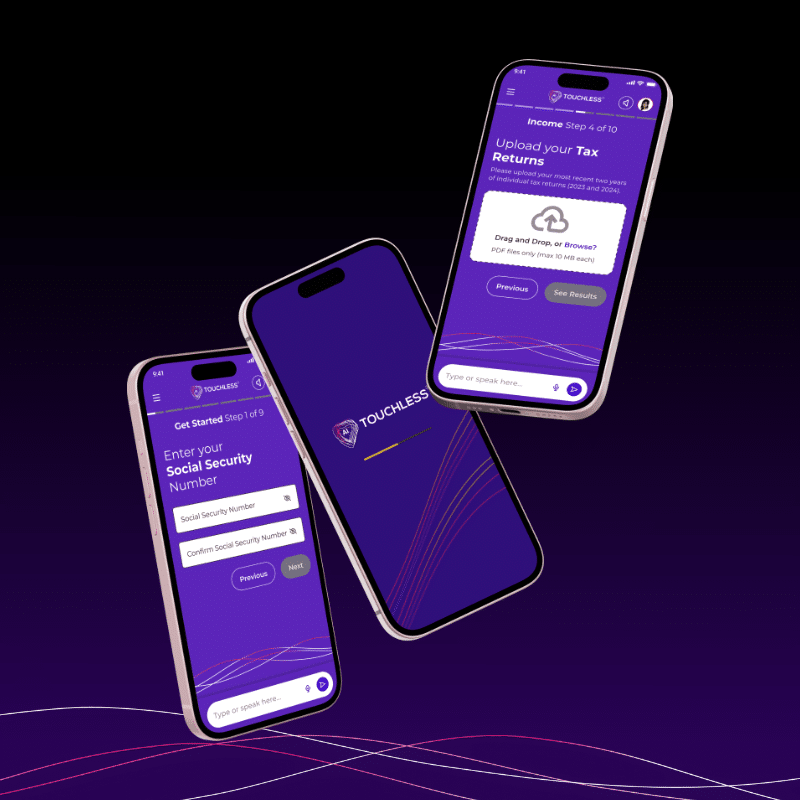
LAS VEGAS, Oct. 20, 2025—Tavant, a leading provider of AI-powered fintech solutions and digital engineering, announced today the release of its industry-leading TOUCHLESS® AI Mortgage Origination Suite. This AI and Agentic AI-powered suite enables end-to-end AI transformation of mortgage origination from lead to funded loan, improving borrower experience, driving up lead conversion, reducing origination cost, and compressing cycle times. It provides a full suite of modules to upgrade existing LOS and POS using Agentic AI Assistants, AI-powered Document Analysis, AI-assisted Underwriting, and an Agentic AI architecture that dynamically personalizes workflows and loan products and programs. “TOUCHLESS® now allows any lender to rapidly transition into the era of AI,” said Mohammad Rashid, Head of TOUCHLESS® at Tavant. “The industry’s promise of seamless borrower experience and lower origination cost has often fallen short. The TOUCHLESS® AI suite allows lenders to rapidly wrap their LOS and POS to unlock higher borrower satisfaction, increased loan volumes, and dramatically lower origination costs. It’s time for the industry to truly move forward and bring the full power of AI to borrowers and employees.” A core innovation of TOUCHLESS® is MAYA™, an intelligent AI assistant that provides personalized, real-time support and feedback throughout the entire application process for borrowers, loan officers, and underwriters. MAYA™ hand-holds borrowers through complicated questions, steps in when they hesitate, and guides applications to submission, increasing conversion rates. It helps borrowers clear conditions, vastly improving the borrower experience. MAYA™ explains nuances in mortgage products and programs and responds 24/7 to leads from digital sources, boosting conversion at key moments of truth across the origination chain. It also increases underwriter productivity when paired with TOUCHLESS® AI-powered document analysis, data consistency checks, automated conditions clearing, and Policy-as-Code underwriting, enabling underwriters to decision a loan in the most efficient way. “With the introduction of our Intelligent AI Assistant MAYA™, TOUCHLESS® is redefining the mortgage origination experience,” continued Rashid. “MAYA™ is human-like and can address any questions and concerns borrowers have and deliver real-time personalized guidance throughout the application process, helping them navigate each step with clarity and confidence. This reduces application errors and abandonment rates, accelerates loan processing, and empowers borrowers and lenders alike with seamless, hyper-personalized support—ultimately saving time and lowering costs for everyone involved.” Pilot implementations with top-tier mortgage originators have shown the transformative impact of TOUCHLESS® AI, boosting underwriter productivity by a factor of twelve, slashing overall operational costs by 60%, and reducing the time to close loans to just a matter of days. Tavant’s TOUCHLESS® AI Mortgage Origination Suite, featuring the AI Assistant MAYA™, AI-powered Intelligent Document Analysis, AI-assisted Underwriting, and the Agentic AI Architecture, will be showcased at this year’s Mortgage Bankers Association Annual Convention in Las Vegas, Nevada, from October 20-22. During this session, the attendees can experience a live, on-stage demonstration highlighting TOUCHLESS® capabilities to super-power mortgage origination through AI. About TOUCHLESS® TOUCHLESS® is the industry-leading, AI-powered suite of software modules allowing any mortgage lender to rapidly transition into the era of AI. Through its core components, MAYA™ – the AI Assistant, AI-Powered Document Analysis, AI-Assisted Underwriting, Agentic AI Architecture, and AI-Driven Executive BI, TOUCHLESS® allows lenders to rapidly wrap their LOS and POS to unlock higher borrower satisfaction, increased loan volumes, and dramatically lower origination costs. Through built-in interoperability with all incumbent LOS and connectivity to more than 200 data, title, and appraisal providers in the mortgage industry, TOUCHLESS® allows lenders to take automation through AI to entirely new levels. TOUCHLESS® super-powers mortgage origination through AI.